
The Psychology of Waitlists and High Prices
You have been told that to get more clients, you need to lower the friction.
Make it easy to buy. Put a “Book Now” button on your homepage. Offer a discount for quick sign-ups. Be available to start tomorrow.
And yet, when you do all these things, you attract a specific type of client. The one who cancels last minute. The one who negotiates your fee. The one who treats you like a glorified task-rabbit rather than a strategic partner.
Meanwhile, you look at the “Top 1%” of coaches and consultants in your niche. Their websites don’t have “Book Now” buttons; they have “Apply to Work with Me” forms. They don’t have discounts; they have waitlists. They are twice as expensive as you, yet they seem to have ten times the demand.
You think: “I’ll do that once I’m famous. Once I have the demand, I’ll raise the price.”
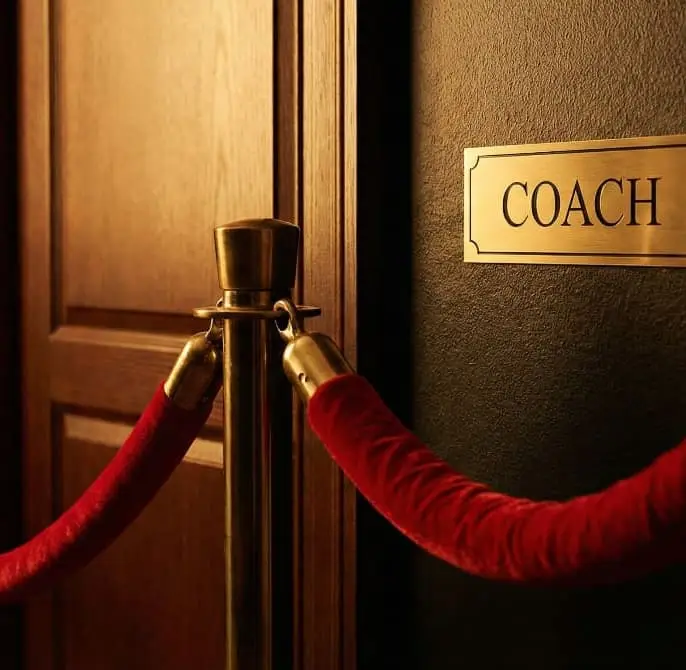
But you have the equation backward. They didn’t get the demand and then build the velvet rope. They built the velvet rope to create the demand.
In the world of high-ticket authority, access is not a right; it is a privilege. And until you treat your own access that way, nobody else will.
The Diagnosis: The Accessibility Paradox
This phenomenon is known as The Velvet Rope Strategy.
It operates on a fundamental rule of human psychology: We value what we have to fight for.
When you are immediately available and affordable, you signal Abundance. In economics, when supply is abundant, value drops. You are inadvertently telling the market, “I am not in demand, so I am easy to get.”
This triggers a subconscious “Buyer Alert” in high-value clients. They wonder, “If they are this good, why are they sitting by the phone waiting for me?”
The Velvet Rope reverses this dynamic. By placing a barrier to entry—a high price, an application process, or a start date that is three weeks away—you signal Scarcity.
You signal that your energy is a finite, premium resource. This moves the client from an “Evaluator” mindset (“Is this coach worth it?”) to a “Competitor” mindset (“Do I have what it takes to get in?”).
The “Old Way” Trap: The “Volume” Model
The standard marketing advice you see online is built for selling widgets, not wisdom. It focuses on “Volume” and “Friction Reduction.”
The “Old Way” tells you to:
- Automate your scheduling so anyone can book you.
- Price your services based on “market averages” so you don’t lose people.
- Say “Yes” to every lead to “fill the funnel.”
This approach traps you in Vendor Energy. You become a commodity. You attract clients who are shopping for the cheapest solution, not the best one.
When you compete on price or speed, you will always lose to someone willing to be cheaper or faster. The Gold Coach does not compete on speed. They compete on Gravity.
The Gold Shift: Pricing as a Filter, Not a Fee
The Gold Shift requires you to stop viewing your price as a “cost” the client pays, and start viewing it as a “filter” the client passes through.
High pricing is a commitment test.
A client who pays $10,000 for a program shows up differently than a client who pays $500. They do the work. They respect your time. They take ownership of the result.
When you raise your price or implement a waitlist, you are not just earning more money; you are curating your environment. You are filtering out the “dabblers” and inviting in the “committed.”
This is the essence of The Status Shift. You stop begging people to buy. You erect a Velvet Rope that says: “This creates results because it requires investment. Are you ready?”
By doing this, you stop “Auditioning” for the client and start “Auditing” them. You become the Prize to be won.
The Protocol: The “Not Yet” Reply
You don’t need a massive waiting list to start using the Velvet Rope psychology. You just need to stop being available “right now.”
Even if your calendar is wide open, you must create Psychological Space.
The Practice:
The next time a potential client asks, “Can we start this week?” or “Can I book a call tomorrow?”, use the “Not Yet” Protocol.
Do not say: “Yes! I’m free all day! Pick a time!”
Instead, say:
“I am currently wrapping up a cycle with a few clients, so I won’t be opening new spots until [Date 2 weeks from now]. However, if you are serious about moving forward, I can open a brief window on Thursday to assess if this is the right fit. If it is, we can reserve your spot for the next opening.”
Why this works:
- It signals demand: “I am wrapping up with clients” implies you are busy and working.
- It creates a “Velvet Rope”: They can’t just “get in.” They have to be “assessed”.
- It increases desire: Suddenly, that “brief window on Thursday” becomes valuable real estate.
Your Next Step
Creating a Velvet Rope feels risky. The fear part of your brain will scream, “What if they say no? What if they go to someone cheaper?”
Let them.
The clients who leave because of a boundary are the clients who would have drained you. The clients who stay—and the ones who fight to get on the list—are the ones who will build your empire.
It is time to stop being the “Open Door” that anyone can walk through. It is time to become the destination.